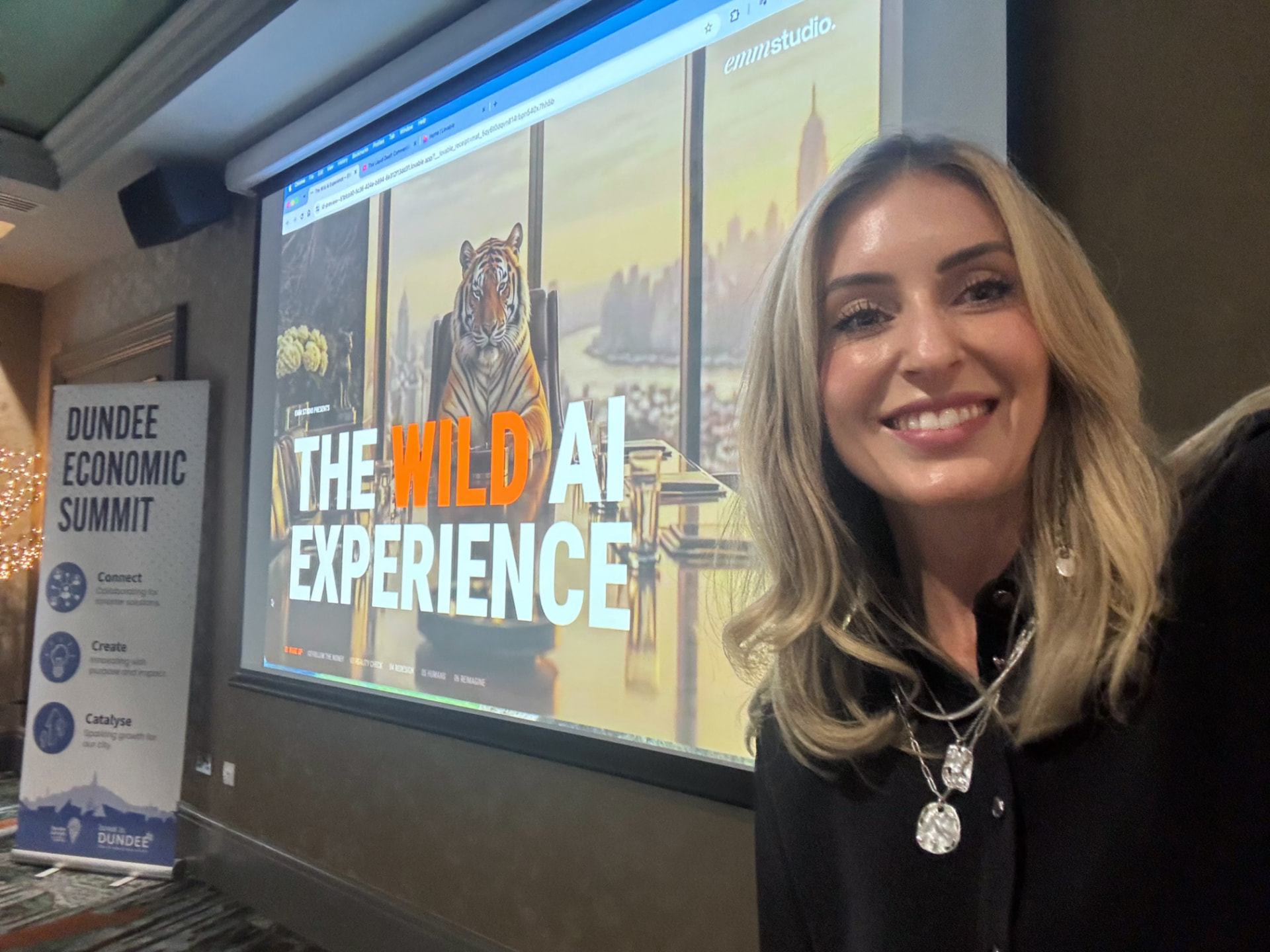
Emily Walters, Founder of EMM Studio, was invited to speak on AI at a Dundee & Angus Chamber of Commerce Leadership Round Table Brunch with Henderson Loggie in Dundee, held at Malmaison Dundee.
This wasn’t really a conversation about which AI tool to buy.
Emily was invited by Dundee & Angus Chamber of Commerce to speak at its Leadership Round Table Brunch with Henderson Loggie. The session brought together business leaders from across different sectors to explore what AI means once organisations move beyond the initial rush of copilots, models, agents and pilots.
The most interesting conversation began when the presentation stopped.
The discussion moved quickly into jobs and skills, judgement, critical thinking, trust, customer relationships, operating models, creativity, legal, tax, HR, hospitality, customer experience and human + agent experiences.
“The interesting part wasn’t the technology. It was everything the technology is starting to change around it.”— Emily Walters, Founder, EMM Studio
Hosted by Dundee & Angus Chamber of Commerce with Henderson Loggie. The discussion sat within Dundee’s wider business and innovation ecosystem, including connections with Techscaler Dundee & Tay Cities.
What I heard in the room mirrors what the global data is beginning to show.
AI adoption has accelerated extraordinarily quickly. Investment has exploded. But value, organisational readiness and operating-model change have not necessarily moved at the same speed.
EMM Studio has combined signals from the leadership discussion with wider AI market evidence to look at where the gap is opening.
EMM Studio AI Market Intelligence
A snapshot of the market behind the leadership conversation.
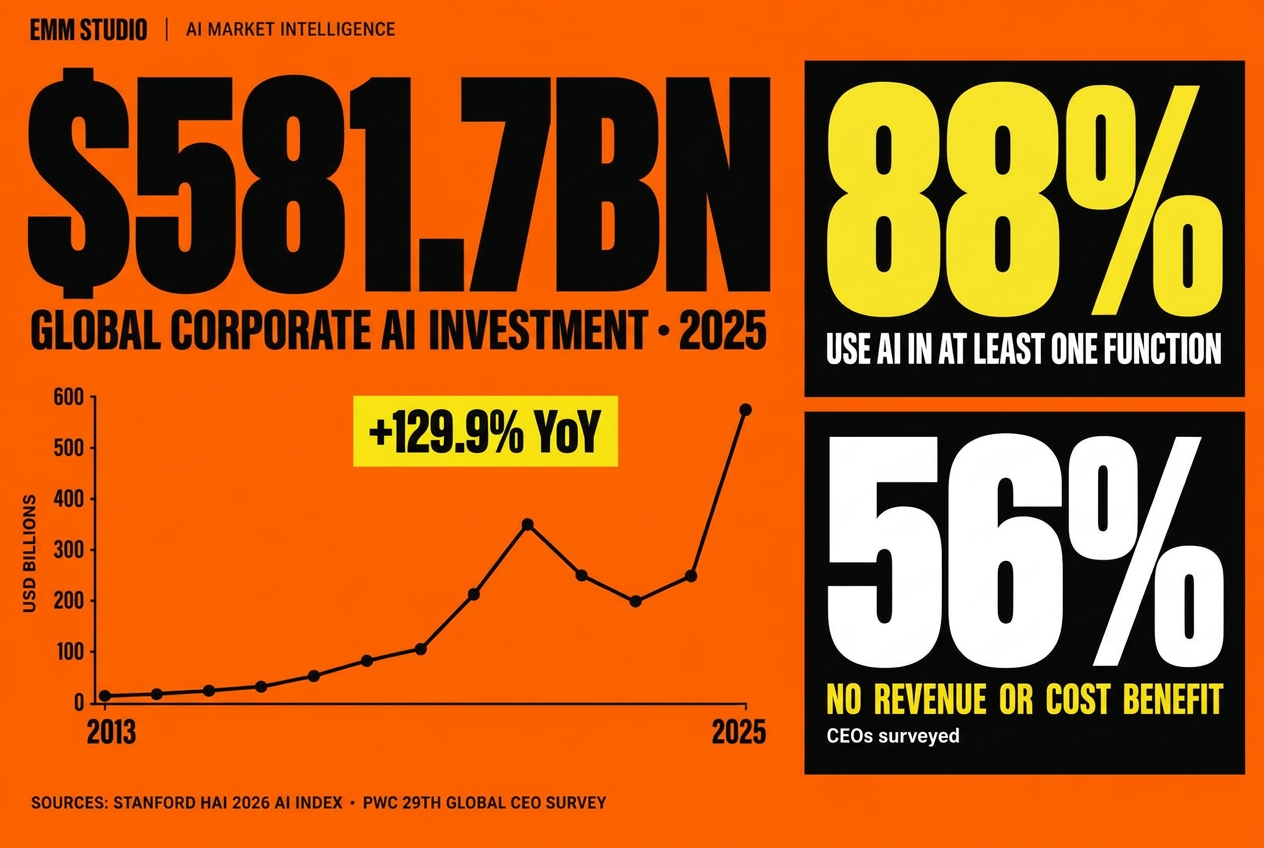
$581.7BN
Global corporate AI investment in 2025
+129.9%
Year-on-year increase in corporate AI investment
88%
Of surveyed respondents say their organisation uses AI in at least one function
53%
Generative AI reached close to 53% population-level adoption within three years
56%
Of CEOs say they have realised neither revenue nor cost benefits from AI
12%
Of CEOs report both lower costs and increased revenue from AI
[ Market data ] Sources: Stanford HAI, 2026 AI Index Report — Chapter 4: Economy (investment data: Quid; adoption: McKinsey & Company State of AI survey); PwC, 29th Global CEO Survey (2026), 4,454 CEOs across 95 countries and territories.
$581.7BN: AI investment just went vertical.
Global corporate AI investment has increased roughly fortyfold since 2013 and more than doubled in 2025.
Global corporate AI investment (USD bn)
View data
| Year | USD bn |
|---|---|
| 2013 | 14.57 |
| 2014 | 19.04 |
| 2015 | 25.43 |
| 2016 | 33.82 |
| 2017 | 53.72 |
| 2018 | 79.62 |
| 2019 | 103.27 |
| 2020 | 221.87 |
| 2021 | 360.73 |
| 2022 | 253.25 |
| 2023 | 201.00 |
| 2024 | 253.02 |
| 2025 | 581.69 |
Source / methodology: Stanford HAI, 2026 AI Index Report — Chapter 4: Economy. Underlying data: Quid, 2025. Includes mergers and acquisitions, minority stakes, private investment and public offerings.
Adoption is no longer the interesting question. Depth of change is.
AI didn’t creep into business. It arrived.
Organisational AI adoption
View data
| Year | Respondents |
|---|---|
| 2023 | 55% |
| 2024 | 78% |
| 2025 | 88% |
53%
Generative AI reached close to 53% population-level adoption within three years of its mass-market introduction — faster than the personal computer or the internet.
Source / methodology: Stanford HAI, 2026 AI Index Report — Chapter 4: Economy. Adoption = share of respondents to McKinsey & Company’s annual State of AI survey who say their organisation uses AI in at least one business function. The annual surveys are self-reported and directional; respondent samples differ each year. The 53% figure is a separate population-level measure of generative AI adoption reported in the same chapter.
Can your organisation change as fast as the technology?
AI is everywhere. Value isn’t.
That tension was central to the leadership discussion.
Businesses are no longer simply asking whether they should adopt AI. They are asking harder questions:
- Where is the return?
- Which pilots should scale?
- What should stop?
- What happens to our data?
- Where does human judgement remain essential?
- What needs to change around the technology?
What CEOs say AI is delivering
- No significant revenue or cost benefit to date56%
- Report increased revenue from AI30%
- Report lower costs from AI26%
- Report both lower costs and increased revenue12%
View data
| Measure | CEOs |
|---|---|
| No significant revenue or cost benefit to date | 56% |
| Report increased revenue from AI | 30% |
| Report lower costs from AI | 26% |
| Report both lower costs and increased revenue | 12% |
These are separate measures and should not be interpreted as a single distribution. Source / methodology: PwC, 29th Global CEO Survey (2026), based on responses from 4,454 chief executives across 95 countries and territories.
A pilot proves possibility. Readiness proves you can repeat it.
The technology wasn’t the most interesting part.
Jobs + skills
Roles are changing before organisational structures catch up.
Qualitative themes identified by EMM Studio from the leadership discussion. This is not a quantitative survey.
The job changes before the title does.

Analyst
Today
Compile information
More value in
Challenge evidence and decisions

Marketer
Today
Create more content
More value in
Protect distinctiveness and customer truth

Manager
Today
Allocate tasks
More value in
Orchestrate people, agents and exceptions

Specialist
Today
Review routine cases
More value in
Own difficult cases, audit and sign-off
If AI removes the junior work, how does anyone learn to become senior?
This became one of the strongest themes in the room.
Many professions historically develop judgement through repeated exposure to the work: research, drafting, reviewing, making mistakes, observing experienced colleagues and recognising patterns.
If AI absorbs more of that early work, organisations also need to redesign how expertise is created. That is an organisational challenge — not simply a technology challenge.
The work is changing before the organisation is ready.
About one-third of organisations surveyed expect AI to reduce their workforce in the coming year — higher at larger organisations (35% at ≥$1bn revenue) than smaller firms (30%). Almost half (43%) expect little or no change.
Separately, the AI Index reports that employment for US software developers aged 22–25 has fallen nearly 20% from 2024. The report describes labour effects as concentrated in hiring pipelines and younger workers in AI-exposed occupations; it does not attribute the decline to AI alone.
Source / methodology: Stanford HAI, 2026 AI Index Report — Chapter 4: Economy, citing McKinsey & Company’s 2025 survey of employer expectations and analysis of US employment data. Expectations are self-reported; they are not observed job losses.
The next capability gap isn’t prompting. It’s judgement.
[ Roundtable signal ]Why judgement matters
Examples from legal, tax and HR made the issue tangible.
AI can create an answer that sounds complete, authoritative, professionally written and convincing. Yet it can still be incomplete, misapplied, contextually wrong — or simply wrong.
As AI becomes more convincing, the human capability to challenge it becomes more valuable.
Capability is scaling. So is risk.
View data
| Year | Incidents |
|---|---|
| 2024 | 233 |
| 2025 | 362 |
+55%
Documented AI incidents rose from 233 in 2024 to 362 in 2025 (EMM Studio calculation from the reported counts).
Source / methodology: Stanford HAI, 2026 AI Index Report — Chapter 3: Responsible AI, citing the AI Incident Database. Counts reflect reported and documented incidents, which depend on media coverage and reporting — not a complete census of harm.
Your business has
a new user.
Who are you designing for? The human? The agent? Both.
- Emotion
- Trust
- Language
- Context
- Experience
- Judgement
EMM Studio AX model. AX = Agentic Experience: the design of how humans, AI agents and organisations interact — deciding where machines should act, where humans should intervene and where trust, accountability and judgement need to remain visible.
The right answer isn’t “AI everywhere”. It is understanding when the machine is appropriate, when the human moment matters more, and how the two should work together.
Try the EMM Studio AI Readiness model.
AI readiness is not one score hidden inside the technology function. It is the combined ability of the organisation to turn AI into repeatable, governed and measurable business value. Move the sliders to see how your weakest dimension shapes the whole.
Interactive demonstration. Your selections are not saved and do not constitute a formal EMM Studio AI Readiness assessment. Levels: Not established (0–19), Emerging (20–39), Repeatable (40–59), Defined (60–74), Measured (75–89), Adaptive (90–100).
You can’t scale past your weakest gate.
A pilot can hide a weak operating model. Readiness exposes what needs to change around the technology.
[ Roundtable signal ]What are you doing with the time AI gives back?
One of the strongest examples from the room came from a business looking at AI not simply as a way to reduce work, but as a way to remove repetitive administration so its people could spend more time on higher-value work.
That changes the business case. Instead of asking “How many hours can AI remove?”, ask “What higher-value activity could those hours create?”
- More Customer time
- More Creativity
- More Collaboration
- More Problem solving
- More Innovation
- More Human judgement
AI should free humans to do the work that matters more — not simply remove humans from the process.

Don’t automate the past.
“How can we make this process 30% faster?”
If we designed this business today, would we do it this way at all?
Reimagine.
Efficiency matters. But the bigger opportunity comes when organisations combine existing advantages — data, customer knowledge, experienced people, trusted relationships, sector expertise, brand and intellectual property — with completely new ways of working.
At that point AI stops being a standalone technology initiative. It becomes a business transformation programme.
The leadership question has changed.
The businesses that succeed with AI will not necessarily be the businesses using the greatest number of tools, models or agents. They will be the organisations that become very good at deciding:
- 01What should we automate?
- 02What should we redesign?
- 03What should we protect?
- 04Where does human judgement matter?
- 05What should our people do more of?
- 06What can we now create that wasn’t possible before?
The companies that win won’t use the most AI. They’ll reimagine the most.
Stay wild.

Emily Walters
Founder, EMM Studio · AI readiness, transformation and operating-model specialist
Emily works with leadership teams to understand where AI can create meaningful business value, how workflows and customer experiences need to change, and what organisations need in place to move from experimentation to repeatable delivery.
AI leadership roundtables
Emily leads executive discussions on AI readiness, business redesign, human + agent working, changing roles and the move from AI experimentation to organisational capability.
Meet EmilyBring the AI leadership conversation into your business
EMM Studio works with boards and leadership teams to explore what AI means for their organisation — where the value sits, what needs to change, what should remain human and what to prioritise next.
Leadership roundtables · Executive workshops · AI readiness · Workflow redesign · Human + agent experience · Rapid prototyping · AI strategy and delivery
Questions
What is AI readiness?
AI readiness is an organisation’s ability to turn AI into repeatable, governed and measurable business value across strategy, leadership, process, data, technology, governance, people and customer experience.
What is agentic experience (AX)?
Agentic experience is the design of how humans, AI agents and organisations interact, including where machines act autonomously and where human judgement, trust and accountability need to remain visible.
Why does human judgement matter in AI?
As AI produces increasingly convincing outputs, employees need the expertise and critical thinking to recognise uncertainty, challenge incorrect conclusions and take accountable decisions.
What is an AI leadership roundtable?
An AI leadership roundtable brings senior decision-makers together to explore how AI affects strategy, operating models, people, customer experience, governance and the wider business — beyond the choice of tools.