

Your business is bigger. So why does everything feel slower?
More people. More technology. More opportunity. More decisions waiting for approval.
This is the scale-up paradox: growth creates value, but it also creates complexity faster than many organisations can manage it.
The business has evolved. The operating model hasn’t.
01 — Growth has a wild side.
A few weeks ago, I attended an event in Glasgow hosted by Evelyn Partners. The room was filled with founders, CEOs, advisers and growth leaders from across Scotland — some scaling rapidly, others navigating succession, investment or digital transformation. One question kept returning all evening.
How do organisations continue to grow without becoming slower?
The symptoms look different in every business. Teams begin operating in silos. Leadership becomes stretched between driving growth and managing delivery. Technology decisions are made without adoption plans. AI reaches the board agenda but practical implementation stays unclear. Underneath, the root cause is usually the same: businesses rarely struggle because they lack ambition — they struggle because growth introduces complexity faster than they evolve their ability to manage it.
Strategy exists. Technology exists. Ambition certainly exists. But somewhere between vision and execution, momentum slows. Decisions take longer. Alignment weakens. Priorities compete.
02 — Technology doesn’t tame a broken operating model.
AI, automation and analytics are no longer reserved for the largest organisations. As access becomes universal, the technology itself stops being the differentiator. The real differentiator is an organisation’s ability to actually use it.
That is a leadership challenge, not a technical one. Technology amplifies existing cultural behaviours. A slow organisation becomes a digitally enabled slow organisation. A centralised decision-making culture becomes a faster centralised culture where the bottlenecks are simply digitised.
Beneath every AI business case sits a more fundamental question: do people feel empowered to think, and trusted to decide? If the answer is no, AI will not remove the operational drag. It will expose it.
Technology may accelerate capability, but execution determines value.
03 — When every decision goes up, momentum goes down.
One of the speakers at the Evelyn Partners event, Gavin Mitchell, referenced David Marquet’s Turn the Ship Around! When Marquet took command of the USS Santa Fe, he inherited one of the worst-performing submarines in the United States Navy — and led it the way most organisations still operate today, by giving instructions.
Then he issued an order the submarine was incapable of executing. The crew acknowledged it anyway. The remarkable part is not that a leader made a mistake; it is that nobody challenged him. Everyone had been conditioned to execute rather than think.
The greatest risk was not incompetence. It was that leadership had become concentrated in too few places, so people stopped thinking because the leader was thinking for them.

Recommended Reading
Turn the Ship Around!
David Marquet’s story of transforming the USS Santa Fe from worst to first through distributed leadership and intent-based command.
Buy on AmazonMarquet’s response was deceptively simple. He changed the language of the vessel. Instead of asking for permission, people declared intent. Asking permission creates followers who wait; declaring intent creates leaders who must analyse the situation before they speak. Decision-making migrated closer to the people with the best information, and performance accelerated.
At EMM Studio we see the same dynamic in growing businesses. Every decision rises upwards. Every approval waits for leadership. Every escalation slows momentum. The organisation becomes larger, but not faster.
04 — Freedom needs guardrails.
Telling teams to make decisions without preparation creates chaos. Real empowerment needs scaffolding: clarity and competence. Competence gives teams the skills and information to make high-quality decisions. Clarity gives them the strategic goals, values and constraints they must decide within.
With both in place, leaders can safely step back. This is often where we work with leadership teams — not defining strategy or selecting technology, but designing the operating models, governance and adoption frameworks that turn strategy into execution.
For founders, this is a psychological shift as much as a structural one. In the early days, the founder’s involvement in every decision is what drives success. At scale, that same behaviour becomes the bottleneck. The role has to move from primary decision-maker to provider of context.
05 — Scale the organisation—not the chaos.
What worked before investment rarely works after it. What worked before AI adoption rarely works once technology is embedded across the organisation. Growth demands a different operating model.
The future will not be won by the businesses with the most advanced technology or the largest budgets. It will be won by organisations capable of unlocking intelligence at scale — where people think critically rather than wait for instruction, and ownership sits closest to the problem.
Technology can increase speed, efficiency and capability. Only leadership can create belief, foster trust and establish the conditions where people contribute their best thinking. The organisations that thrive will be those that translate strategy into execution, align people around change, adopt technology without creating complexity, distribute decision-making without losing control, and scale leadership faster than they scale headcount.
Acknowledgements
This article was inspired by discussions at Entrepreneurial Minds: Beyond the Deal, hosted by Evelyn Partners in Glasgow.
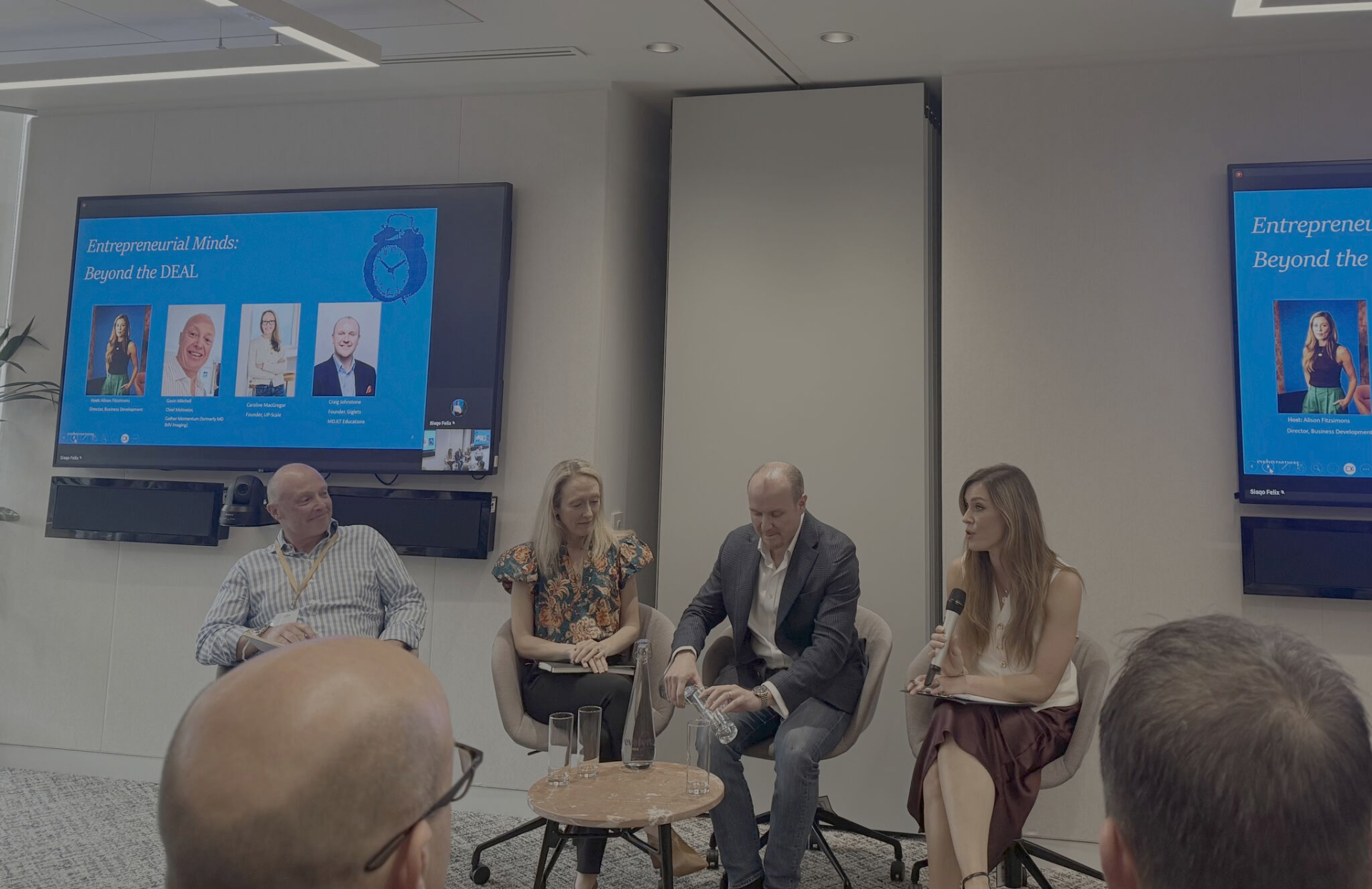
My thanks to Alison Fitzsimons and Paul Frame for bringing together such a thoughtful group of founders, investors and business leaders.
Particular thanks to the evening’s panel speakers:
- Caroline Macgregor, Founder and CEO of UP-Scale, whose insights on scaling organisations, leadership alignment and the human realities of growth reinforced the importance of building leadership capability throughout a business.
- Craig Johnstone, founder of Giglets and now CEO UK & International at ILT Education, who shared candid reflections on growth, acquisition, earn-outs and the transition from founder-led business to investor-backed scale.
- Gavin Mitchell, entrepreneur and growth leader, who offered valuable lessons from building, scaling and exiting international businesses, particularly around private equity, governance, delegated authority and the distinction between builders and optimisers.
While this article draws on themes discussed during the event, the views and reflections expressed are my own.
Emily Walters is Founder of EMM Studio, helping organisations bridge the gap between strategy, technology and execution during periods of growth, transformation and AI adoption.