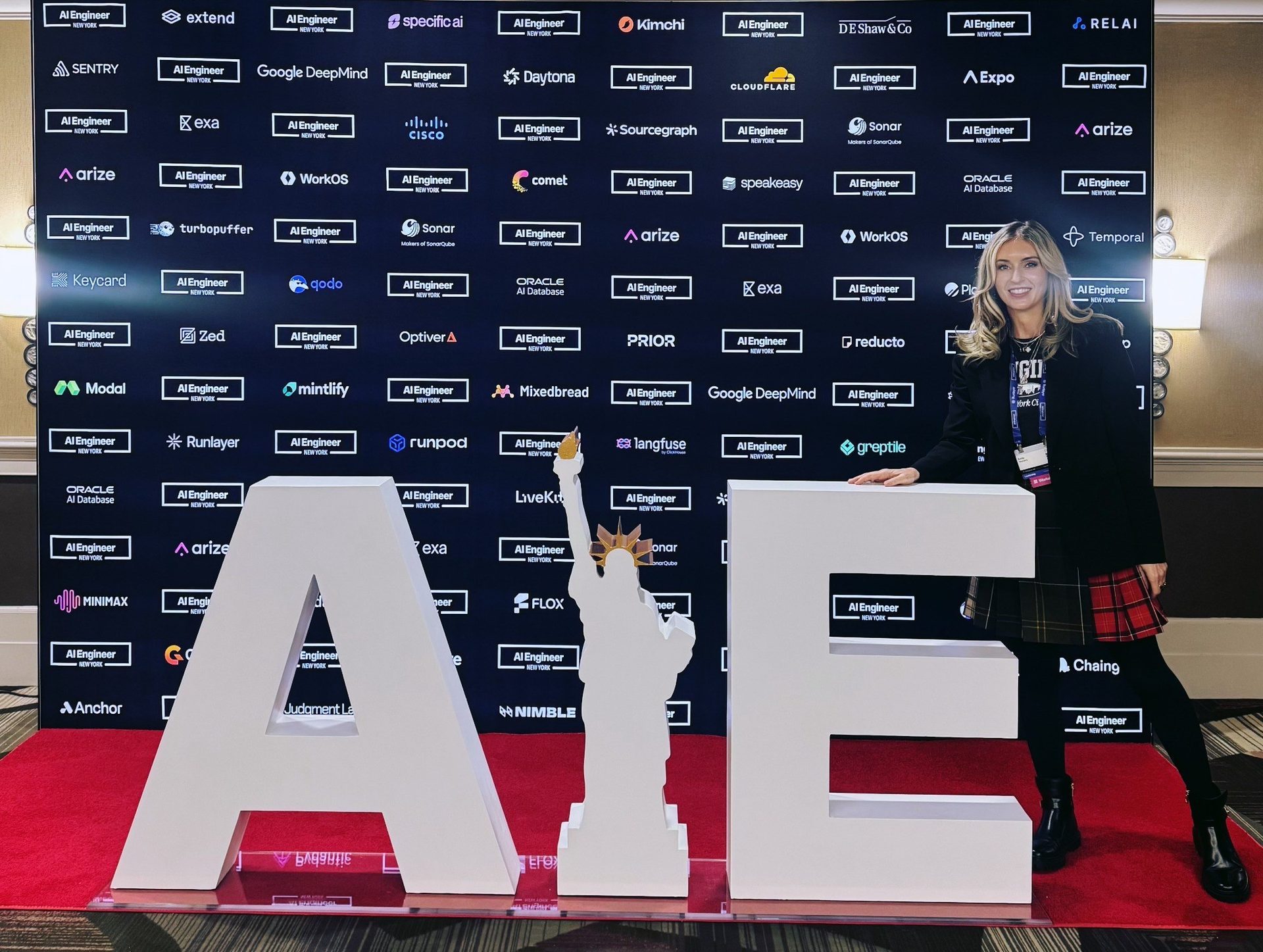
I didn’t arrive at AI Engineer New York simply as a delegate looking for the next breakthrough. Two decades of turning complex transformation into deliverable change gives you a different lens on three days in Times Square: not just what the technology can do, but what leaders will have to change to make it deliver.
The questions I brought are ones any scaling business will recognise. How do you mobilise quickly without losing what makes the organisation special? How do you build the processes, collaboration and operating rhythm to match the ambition?
So I watched the stage with two questions in mind. What are the most advanced engineers actually building? And what do their discoveries mean for the CEOs, boards and leadership teams who have to turn AI capability into results?
Why a conference for engineers matters to CEOs
AI Engineer is a conference and community for the practitioners turning foundation models into working software. Shawn “swyx” Wang’s 2023 essay, “The Rise of the AI Engineer”, helped name the role; the first summit followed that October. The New York edition, held 12–14 October 2026, carried an explicit theme: “Where AI Engineering Meets Wall Street.”
That theme is the reason leaders should pay attention. Alongside frontier model builders such as Anthropic, OpenAI and Google DeepMind, the programme featured banks, investment managers, financial-data businesses, insurers and AI-native product companies. Financial services supplies some of the hardest, most consequential tests of what production AI can do: confidential data, accountable decisions and regulators who expect evidence.
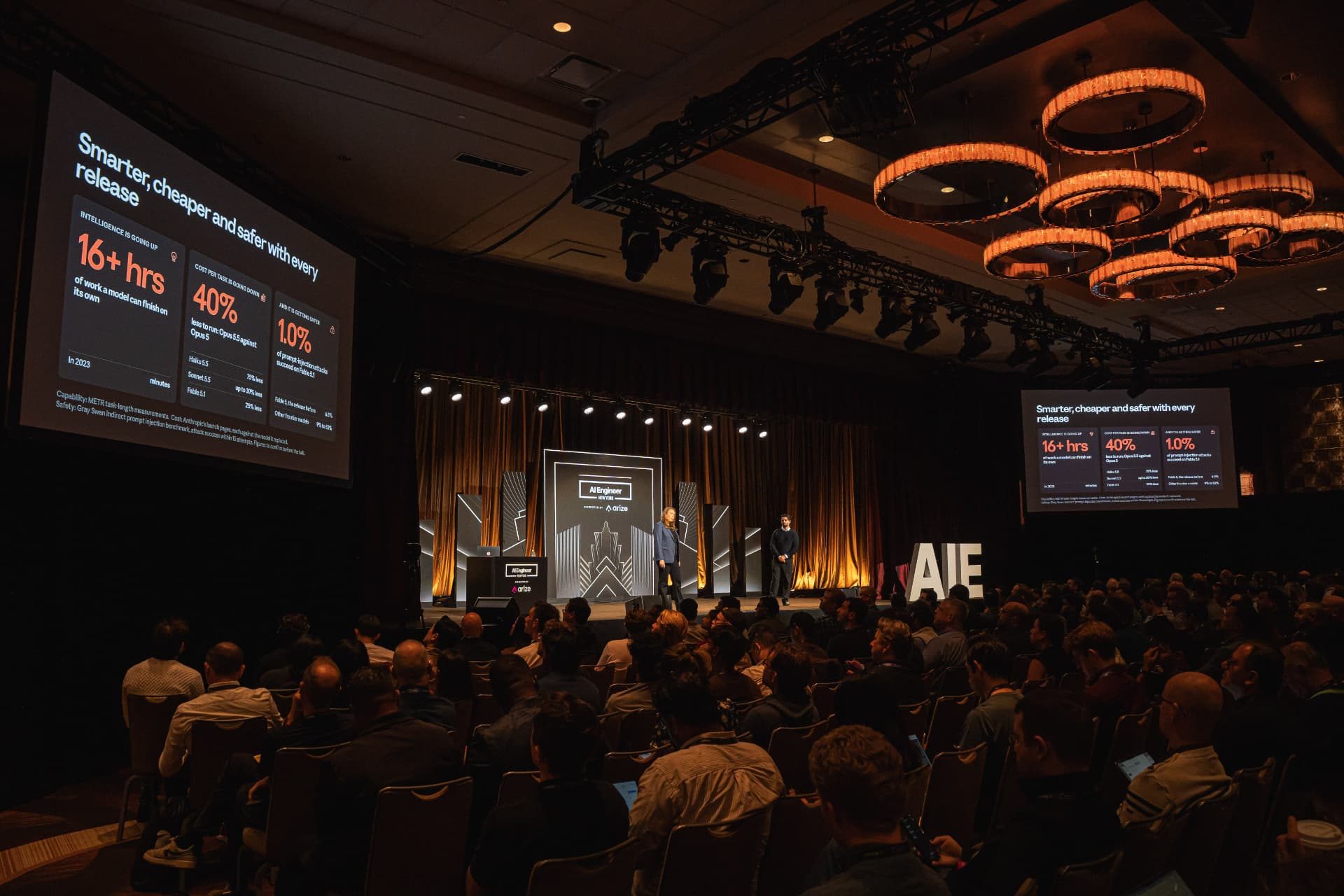
Firsthand Between sessions, the hallway conversations were as revealing as the keynotes. Engineers compared evaluation set-ups. Enterprise teams asked how others had passed security review. Founders tested ideas on the people who would have to run them. This was not a room debating whether AI works. It was a room working out how to make it work reliably, inside real organisations.
The ten things I heard — and what they mean for leaders
1. Evals were everywhere
In keynotes, breakouts and hallways, I heard “evals” more than almost any other word. An eval — short for evaluation — is a repeatable test of whether an AI model or agent does a defined job well enough: correctly, reliably, safely and at an acceptable cost. Many executives have never heard the term. That gap matters, because evals are becoming the evidence on which trust, model choice and safe autonomy depend. Part 2 explains evals in plain English.
2. Agents are moving from assistance to multistep work
Engineers described agents that inspect traces, open pull requests, review code and propose fixes. At Arize — which builds AI observability and evaluation tools — an always-on system read traces, identified recurring defects and proposed code fixes. Aparna Dhinakaran, Arize’s co-founder and CPO, put the shift in a single line:
“As an AI engineer, your job is no longer to just write the feature.”
EMM Studio analysis If agents increasingly help build and maintain other systems, leaders will need to decide who supervises them, what they may change, and what evidence is required before a change goes live.
3. Building is easier. Production is not.
The most honest line of the week came from John Stecher, CTO of Blackstone, the alternative asset manager, in the “Built to Scale” session: “I still think the hard yards for a lot of development out there is getting it to production.” A prototype is built against a clean sample. A live system has to work with historic technology estates, scattered data, permission rules, security review, monitoring and support. Part 3 explores why this is especially hard in financial services.
4. Engineering experience has returned to the centre
Tariq Shaukat, CEO of Sonar — which builds code-quality and code-security tools — revisited the lessons of quality-engineered manufacturing. Fix root causes. Build quality into the process. AI changes the speed and cost of producing code; it does not abolish architecture, testing, version control or the need for a responsible owner. Part 4 unpacks the stack and the harness.
5. Tokens have become an economic language
Tokens — the units of information AI models process — had their own velvet rope at the venue, in the Token Billionaires Lounge. But token consumption is not a business result. Eugene Cheah of Featherless AI argued that the real task is optimising the cost per task, not the price per token. Part 5 looks at the AI bill.
6. Harnesses and shared foundations
Anthropic’s financial-services keynote, delivered by Belinda Neal and Keon Shahab, made the next bottleneck explicit with a slide that read: “The model is no longer the constraint. Building every agent by hand is.” The answer presented was a shared foundation — connectors, documented skills, scoped permissions, human approval and evals — that each new agent inherits. The question shifts from “how many agents do we have?” to “what does each new agent inherit from the last?”
7. Better AI does not automatically create better businesses
One presentation contrasted two companies using the same AI. One layered tools onto existing work and captured local gains. The other redesigned the workflow and built shared capabilities, so improvements compounded. A Featherless slide made a related point: “People get faster. Organizations don’t.” Individual speed can simply disappear into a longer review queue.
8. Workflow redesign and compounding capability
Sid Pednekar, PhD, an AI, technology and data executive at Millennium, the global investment firm, offered the line I’ve repeated most since: “The winners don’t just automate. They redesign.” His follow-up question was just as sharp: “The individual learned. Did the system?” Part 6 is about redesign.
9. Human judgement, creativity and leadership
The conversation was as much about judgement and imagination as about models. Cristóbal Valenzuela, co-founder and co-CEO of Runway, showed early research turning static information into visual, interactive experiences — “We call this visual thinking.” EMM Studio analysis The significance for leaders isn’t that every training module becomes a game. It’s that the way people understand, rehearse and redesign work may change.
10. Who builds the future matters
Firsthand I have long advocated for more women in technology. From where I was sitting, women appeared visibly outnumbered in the audience — a personal observation, not an audited count. Yet accomplished women were at the centre of the programme: Aparna Dhinakaran on building the loop that evaluates and improves products; Belinda Neal on separating what an agent may investigate from what it may change; Lia McBride opening the conference; Ksenia Se of Turing Post as MC; Allie Howe of Keycard on what an autonomous agent is permitted to do, and on whose authority. We should celebrate them — and ask what we are doing to ensure there are many more of them in the room, behind the architecture and leading the companies next time.
What this means for the boardroom
EMM Studio analysis AI capability is becoming easier to access. The scarce capability is the ability to redesign work, coordinate people and agents, build trusted foundations and learn systematically from each deployment. That points to a different kind of investment decision: fund an operating-model transformation, not a collection of unrelated pilots.
- Redesign before automating. Start with the customer or operational outcome that should change, not the number of tasks AI could perform.
- Build once, improve repeatedly. Shared context, evaluation, data access and controls let the next team start further ahead.
- Make quality and cost visible. Choose models by task difficulty, required reliability and the cost of a successful outcome.
- Govern autonomy as an operating risk. Permissions, approvals, monitoring and audit trails are design requirements, not paperwork.
- Turn correction into learning. A corrected answer helps once; a validated workflow improvement helps every run after it.
Six questions for your next executive meeting
- 01Which business outcome are we changing, and why now?
- 02What work should disappear, not just become faster?
- 03What must humans still decide, approve or own?
- 04Which capabilities can every future team reuse?
- 05What is the cost per reliable outcome, including review and failure?
- 06What did the system learn, and how will the next run improve?
EMM Studio AI Advantage Framework — EMM Studio synthesis, not conference consensus.
The better question
I left New York thinking about possibility rather than efficiency alone. The most compelling answers kept involving familiar disciplines — process design, quality, governance, sound engineering and people working together. That is good news for leaders: the advantage is not reserved for whoever has the biggest model budget. It goes to the organisations willing to redesign how they work.
So the question I’d put to any leadership team is not simply how can we use AI? It is this:
Go deeper: the five-part series
- Part 2 · AI Explained“Evals.” The Word I Heard Everywhere in New York.
- Part 3 · Financial Services & AIWhy Getting AI Into Production Is Still So Hard for Banks and Investment Firms.
- Part 4 · AI Engineering & TransformationEveryone Can Build With AI. Not Everyone Can Engineer It to Scale.
- Part 5 · AI EconomicsThe AI Bill Is Getting Bigger. But Are Businesses Measuring the Right Thing?
- Part 6 · Operating Model & TransformationThe Winners Won’t Just Automate. They’ll Redesign How Work Gets Done.
The question to take into Monday
What should we now dare to reimagine?
Related reading