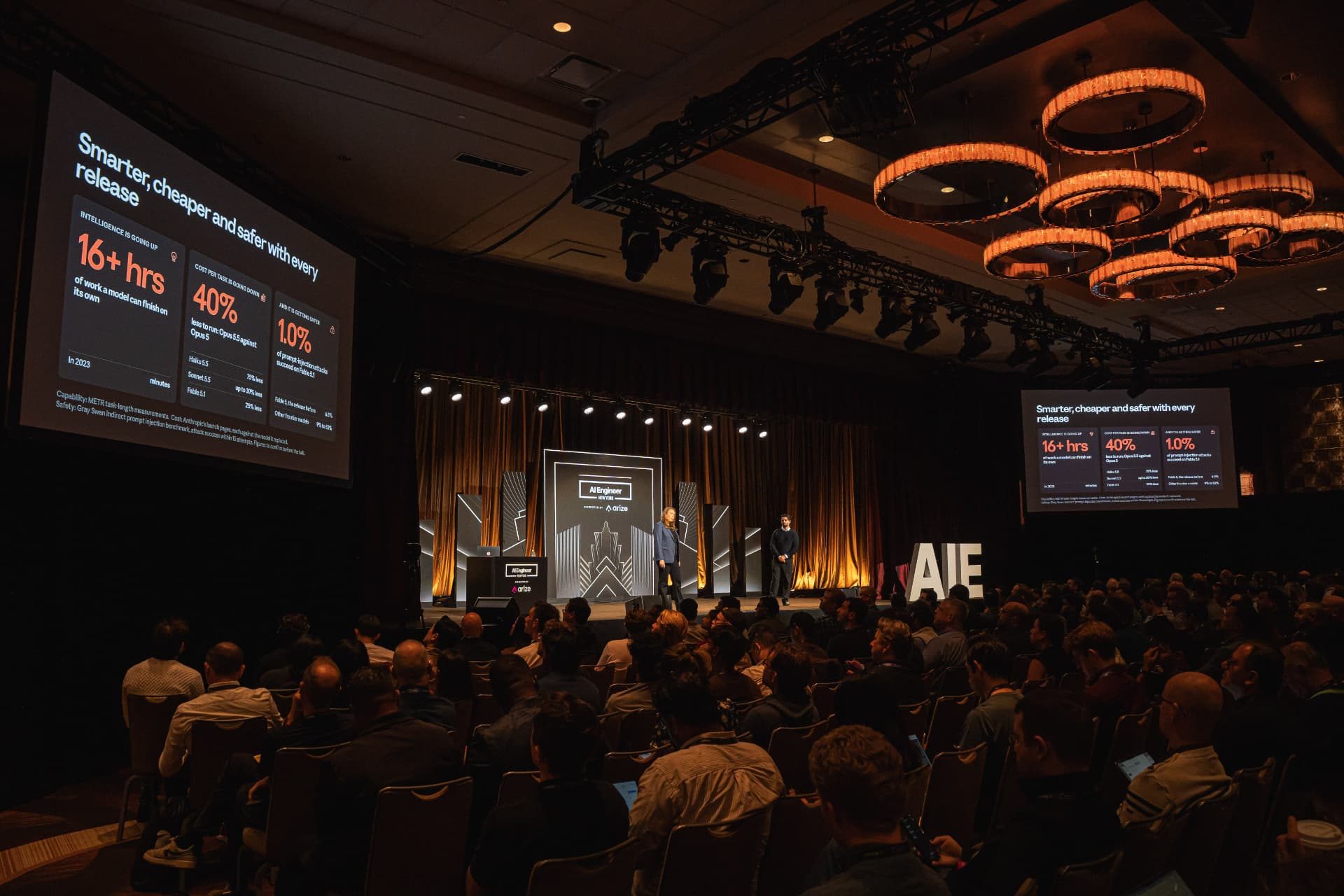
In keynotes, breakouts and hallway conversations at AI Engineer New York, one word came up more than almost any other: evals. Many executives have never heard it. By the end of the three days, I was convinced it should be on every board agenda that includes AI.
What is an eval?
An eval — short for evaluation — is a repeatable test that checks whether an AI model or agent does a defined job well enough: correctly, reliably, safely and within an acceptable cost.
Think of it as quality assurance for AI. Instead of asking “did the demo look good?”, an eval asks the system to perform the real task, on real and difficult examples, and scores the result against criteria the business has agreed in advance. Then it does it again — after every change to the model, the data, the instructions or the process.
Why a polished demo isn’t evidence
A demonstration shows that something can work, usually on examples chosen because they work. Production is different. Customers ask unexpected questions, data is incomplete, tools are unavailable and edge cases arrive at volume. Traditional software is largely deterministic: given the same input, it produces the same output, so you can test it once and trust it. AI models are probabilistic — they generate likely answers from learned patterns — so the same question can produce different results, and a small change can improve one behaviour while quietly breaking another.
That is why evals have moved from a niche engineering practice to the centre of the conversation. At the conference, they were discussed as a prerequisite for trust, for safer autonomy, for choosing between models and for scaling commercially. Evals turn an impression into repeatable evidence. They do not, on their own, guarantee safety.
- 01Test casesReal, representative and difficult examples
- 02Agent executionThe agent does the task as it would in production
- 03ScoringAccuracy, evidence, safety and cost
- 04Expert reviewSpecialists read what went wrong, and why
- 05Improve and re-testBefore release and after every change
EMM Studio diagram, adapted from The AI Advantage report, p20.
What an eval looks like in practice
Imagine a retail bank preparing to launch a customer-service agent. Before a single customer sees it, the team runs it against thousands of past conversations, the bank’s knowledge base of products, fees and policies, and examples of complaints that were resolved well. Each answer is scored on several dimensions:
- Accuracy — is the answer right overall?
- Correctness — are specific facts, such as fees and rates, exactly right?
- Completeness — does it include everything the customer needs?
- Groundedness — is the answer supported by the bank’s own approved sources, or has the model made it up?
- Safety — did it avoid restricted data and unapproved actions?
- Overall accuracy71%How often the answer was judged right overall
- Completeness73%Missing key details on product returns
- Correctness24%Fee and rate figures were incorrect
- Groundedness32%Answers not found in the knowledge base
How to read it: the agent answers hundreds of real customer questions, and each answer is scored against the bank’s own records. The scorecard shows not only how often it is right, but where it fails. Here, weak correctness on fees would stop the launch.
Illustrative scores, after a public evaluation-dashboard example shared with EMM Studio. Scenario: EMM Studio illustration, from The AI Advantage report, p21.
The headline accuracy figure might look tolerable. The detail tells a different story: the agent is getting fees and rates wrong, and many answers can’t be traced to the bank’s own records. In a regulated business, that is not a tuning issue. It is a launch blocker. The eval has done its job — it has found the failure before the customer did.
The question is not “does it work?” It is “where does it fail — and how do you know?”
Before go-live, and every day after
Evals are not a one-off gate. Models are updated by providers. Instructions are rewritten. New data sources are connected. Each of those changes can alter behaviour. The organisations that scale AI confidently re-run their evals whenever something material changes, and monitor live performance continuously.
That is where evals connect to three disciplines leaders may already know:
- Software testing. Evals extend the logic of automated testing to systems whose outputs vary. Conventional tests still matter for the deterministic parts — calculations, permissions, business rules.
- Observability. Traces record what the system actually did: which data it retrieved, which tools it called, which steps it took. Evals tell you whether the result was good enough. You need both — one to see, one to judge.
- Human oversight. Experts define what “good” means, review failures and approve consequential actions. An eval is only as good as the judgement built into it.
EMM Studio analysis This is also why evals are a business responsibility, not just a technical one. The people who understand the work — the complaint handler, the fund accountant, the clinician — are the ones who know what a dangerous mistake looks like. Their expertise should shape the test cases.
A second example: quarterly reporting
The same approach works far beyond customer service. For an agent preparing quarterly financial reports, an eval might ask: are the figures reconciled to approved sources? Were all funds, periods and exceptions included? Can a reviewer see where each number came from? Did it avoid restricted data? And what does each accepted report cost to review? Illustrative example
Questions for CEOs and CTOs
- 01Show me the failures you test for, how you measure improvement and what would stop this agent going live.
- 02Who in the business defined what “good” looks like — and who reviews the failures?
- 03Which of our test cases are real, difficult examples rather than curated ones?
- 04What happens to the evals when the model, data or instructions change?
- 05Can we see traces of what the system actually did, not just its final answer?
- 06What does each accepted, quality-checked outcome cost — including human review?
The first question is the CEO question from The AI Advantage report, p20. Others: EMM Studio analysis.
The question to take into Monday
How does your organisation know its AI is performing reliably?
Related reading