Of everything I heard in New York, one slide has stayed with me most. It didn’t describe a new model or a new tool. It described the difference between two organisations with access to exactly the same AI.
“The winners don’t just automate. They redesign.”
Same AI. Different organisations.
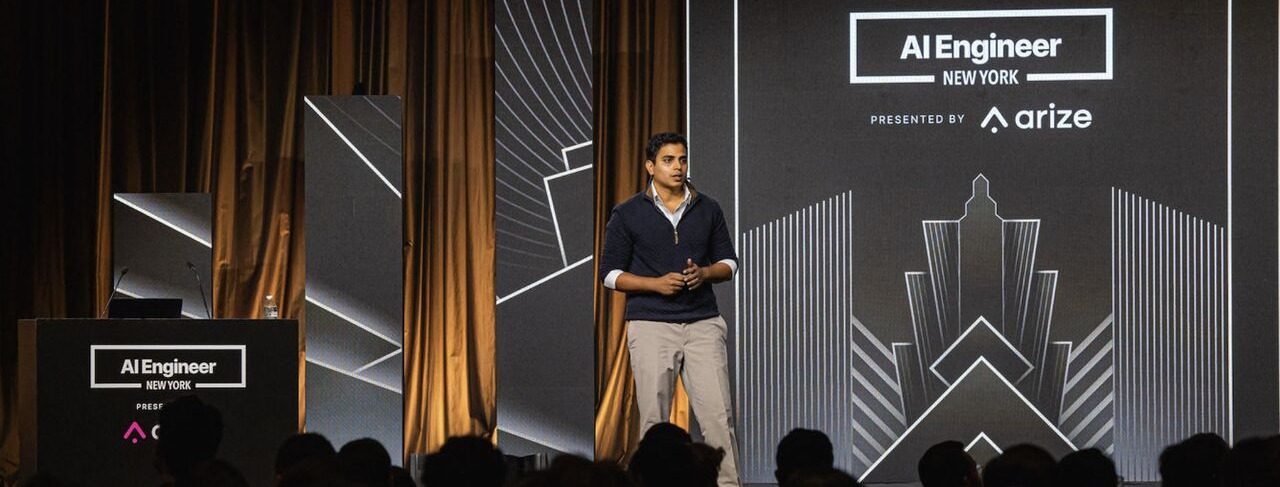
Sid Pednekar, PhD, is an AI, technology and data executive at Millennium, a global, diversified alternative investment firm. His AI Engineer New York presentation started from a premise every leader should sit with: better AI is becoming available to everyone. If two companies have access to the same models, the difference in outcome must come from somewhere else.
Company B adds AI to existing tasks. Reports arrive faster. The gains are real, but they stay local — one team, one process, one productivity win. Company A starts from the outcome. It rebuilds the whole workflow around what AI makes possible, builds capabilities that other teams can share, and treats every correction as a chance to improve the system.
- Starts from the outcome
- Rebuilds the whole workflow
- Every correction compounds
- Adds AI to existing tasks
- Reports arrive faster
- Gains stay local
EMM Studio comparison, adapted from Sid Pednekar’s “Same AI. Different organizations.” slide (slide wording).
Sid framed the path in three steps: design the right problem, build shared capabilities, and compound the advantage. And he was clear about the goal:
“The goal is a more effective organization – not just a faster system.”
An example: investment research
Illustrative example Sid used an investment-management scenario to make the contrast concrete — illustrative, not a description of his own firm. In the reactive model, an earnings event triggers the work. Analysts search, update and draft, and AI helps write the note. People do the work; AI assists.
In the continuous model, people set the investment thesis and the things worth watching. AI agents monitor continuously and surface relevant changes. Scenarios are ready before they are needed. AI does the watching. People decide. The analyst’s job hasn’t disappeared — it has moved up, towards judgement.
- 01An earnings event triggers the work
- 02Analysts search, update and draft
- 03AI helps write the note
- 01People set the thesis and watchpoints
- 02AI agents monitor and surface changes
- 03Scenarios are ready before they are needed
EMM Studio visual, adapted from Sid Pednekar’s slide “The winners don’t just automate. They redesign.” An illustrative scenario, not a description of his firm.
AI frees capacity. Where does it go?
EMM Studio analysis This is the question most AI business cases skip. If an AI tool saves an hour, that hour goes somewhere. Without deliberate design, it is absorbed — into more reports, more drafts, more meetings, or a longer review queue. A Featherless AI slide at the same conference put it bluntly: “People get faster. Organizations don’t.”
| If AI saves time in… | Low-value response | Higher-value response |
|---|---|---|
| Reporting | Produce more reports | Improve decision speed and quality |
| Operations | More throughput without redesign | Remove handoffs, cut end-to-end cycle time |
| Customer service | Answer more queries | Resolve more issues first time |
| Knowledge work | Generate more drafts | Improve judgement, oversight, client engagement |
EMM Studio analysis, The AI Advantage report, p29.
“The individual learned. Did the system?”
Sid’s second big idea was about learning. When an expert fixes an AI answer, the expert has learned something about where the system fails. But unless that fix is captured, the next person hits the same problem. The individual learned; the organisation didn’t.
A corrected answer helps once. A validated workflow improvement can help every run after it. That is how AI-generated output, human judgement, validated learning and reusable methods should interact: the AI produces; the human judges and corrects; the correction is validated by a responsible owner; and the validated lesson becomes a test, a rule, a better instruction or a reusable component that the next run inherits.
- 01Error spottedAn error, exception or user correction is observed
- 02Expert correctsRoot cause classified: data, instruction, tool, permission or workflow
- 03Fix validatedConfirmed by a responsible owner
- 04Rule savedBecomes a test, rule or reusable component
- 05Next run improvesRe-evaluate and monitor for regressions
Step labels adapted from Sid Pednekar’s learning-loop slide; details are EMM Studio analysis (report p39).
For most enterprises, this isn’t model training. It is disciplined feedback capture, evaluation and process improvement. Anthropic’s keynote described the same pattern in financial operations — a professional corrects the agent, the correction becomes a skill change and a test, and engineering controls the release. (See Part 3.)
The architecture of compounding advantage
- Redesign the work. Remove unnecessary steps, approvals and handoffs rather than speeding each one up.
- Standardise the core. Share data access, permissions, evals and components; customise at the edges.
- Capture feedback. Turn errors and expert corrections into validated tests and improvements.
- Reallocate capacity. Use freed time for judgement, oversight, complex cases and growth.
Where to start
EMM Studio analysis This is the work EMM Studio does with leadership teams. It starts with an honest understanding of the current state: how work really flows, where the handoffs and delays sit, what data exists and who decides. Then it designs the future state around the outcome, not the tool — bringing business, operations, technology, risk and people teams into the same room, because none of them can redesign the work alone. Visual prototyping makes the new way of working tangible before anyone commits to building it. And every change is tied to measurable outcomes from the start.
If that sounds like operating-model transformation rather than an AI project, that’s the point. We made the same argument in We’ve Crossed the AI Adoption Chasm. Now Comes the Wild Part. — adoption is happening; transformation is the work. And in AI Can Make Almost Anything, we explored why imagination and judgement become more valuable when making gets easier.
Questions for leaders
- 01If our organisation were designed today, which parts of the current workflow would we choose not to rebuild?
- 02Which outcome are we redesigning around — and who owns it?
- 03When AI saves time, where does that time go?
- 04When an expert corrects AI, how does that correction reach the next run?
- 05Which capabilities are we building once, for every team to reuse?
EMM Studio analysis, from The AI Advantage report, pp29, 35, 39 and 45.
The question to take into Monday
If AI gives your people time back, what should they do differently?
Related reading