AI-assisted tools have made a proof of concept quick and cheap. Putting that proof of concept into sustained operation inside a bank or investment firm is a different discipline altogether. At AI Engineer New York, some of the most senior technology leaders in financial services said so plainly.
“I still think the hard yards for a lot of development out there is getting it to production.”
The hard yards
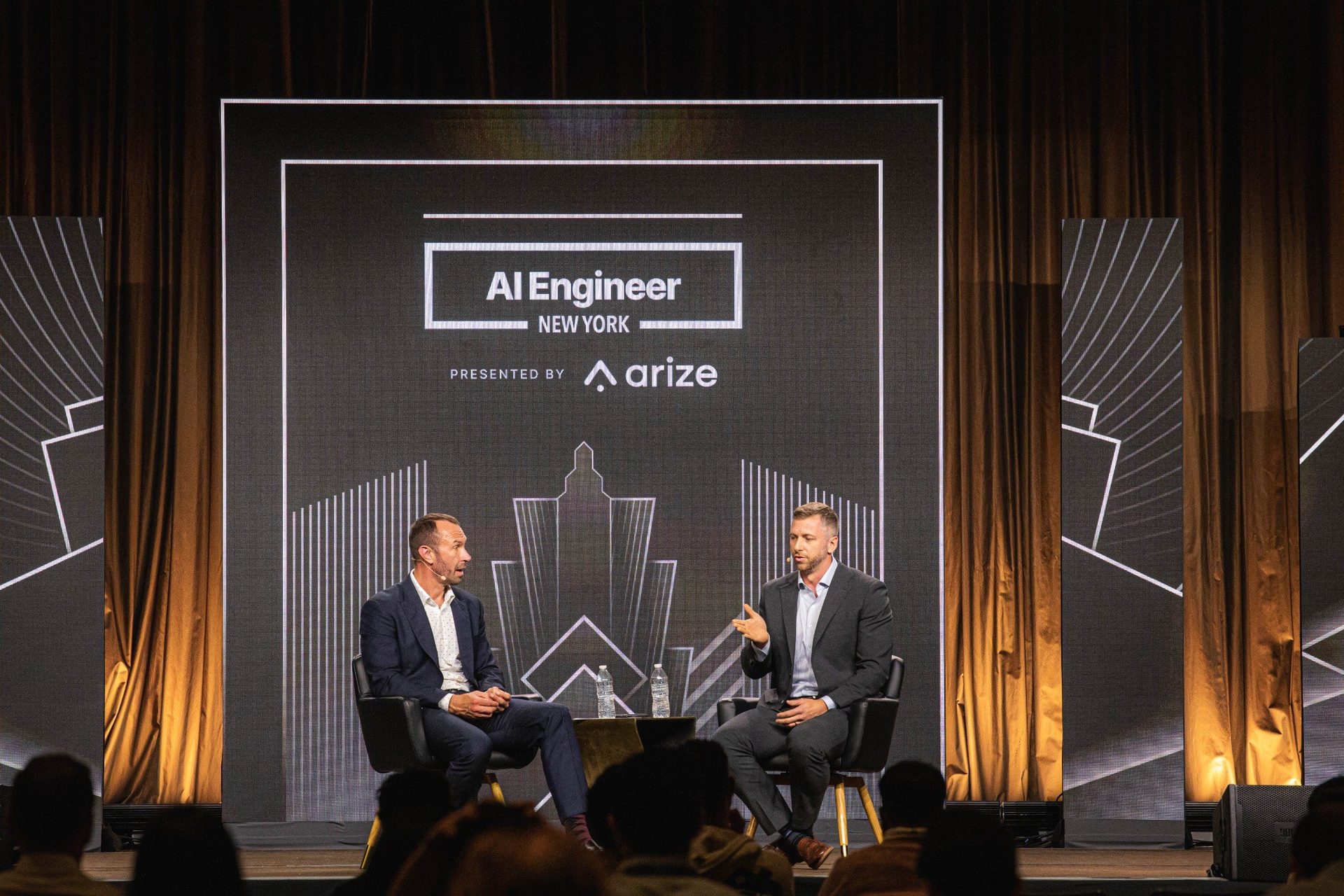
Blackstone is one of the world’s largest alternative asset managers — an investment firm, not a bank. In “Built to Scale: Future-Proofing Your Technology Roadmap”, its CTO John Stecher was in conversation with Scott Worland, CTO of Norm Ai, which builds AI agents for regulatory and compliance work. Their distinction was simple and important: building something that works is no longer the hard part. Getting it to production is.
A prototype is built against a clean sample. A live system has to work with historic technology estates, information scattered across many systems, detailed permission rules, security review, monitoring, support rotas — and someone who is accountable when it fails at 2am.
Proof of concept vs production system
EMM Studio analysis A startup can often launch with a clean data model and a handful of decision-makers. A global financial institution may have dozens of core platforms, historic permission rules, audit requirements and teams that cannot stop operating while the technology changes. To go live, an AI system has to solve four things a demo never touches:
- Data and integration. Core-system information accessible with the right permissions, lineage and quality, through approved interfaces.
- Security and change control. Risk review, identity and access checks, approval boundaries and controls on changes to critical systems.
- Reliability and support. Traceable execution, production monitoring, incident management, fallback routes and a named service owner.
- Value beyond the demo. Evidence that the workflow improves the outcome once implementation, maintenance, review and risk costs are counted.
Banks face a related but distinct version of the challenge. On top of the same engineering estate they carry prudential regulation, model-risk management and consumer-protection duties, so the bar for evidence before an agent can act is higher still.
| Question | AI-native product business | Large regulated firm |
|---|---|---|
| Who can decide? | Often a small product team | Multiple accountable owners and control functions |
| What data is available? | Potentially product-native | Fragmented, permissioned, historically inconsistent |
| What can go wrong? | Product defects and customer loss | Financial loss, misconduct, outages, regulatory exposure |
| What must be proved? | Product-market fit and technical reliability | Reliability plus auditability, resilience and governance |
EMM Studio analysis, from The AI Advantage report, p27.
Anthropic: two frontiers
Anthropic — the AI company behind the Claude models — gave a main-stage keynote titled “Accelerating Frontier AI in Financial Services”, delivered by Belinda Neal, Managing Director, Financial Services, and Keon Shahab, Applied AI Architect.
Their framing was useful for any board. There are two frontiers. The frontier of intelligence is what the most capable model can do today. The frontier of adoption is how much of an organisation’s actual work has been redesigned to benefit from it. Model intelligence can improve faster than a financial institution can change its systems, approvals, processes and culture. That gap is both the opportunity and the risk — the risk being a portfolio of impressive pilots that never become an operating advantage.
- 01Exploration — a year agoPilots and proofs of concept. Built by a few engineers.
- 02Production — this yearA handful of agents, each built by hand. Built by engineering teams.
- 03Scale — Anthropic’s future scenarioThousands of specialists on one foundation. Built by engineers and the business.
Stage wording: direct slide text from Anthropic’s keynote. The third stage was presented as a forward-looking scenario, not a guaranteed prediction.
“The model is no longer the constraint. Building every agent by hand is.”
From hand-built agents to a governed foundation
A convincing demonstration can be assembled by connecting a model to a few files and systems. But an enterprise supporting dozens or hundreds of agents can’t afford a different connector, a different set of instructions and a different control model for every one. Keon Shahab described five layers that every new agent can inherit:
- 1Connectors“Wire each system once. Control it in one place. Any agent can use it.”Can it reach authorised systems and data?Secure connections are built once — to market data, orders, payments, documents and CRM — rather than wired separately into every agent. MCP was among the connection standards mentioned.
- 2Skills“Write the method down once. The model becomes a specialist.”Does the agent understand how the organisation does the work?A general-purpose model needs the firm’s actual procedures: checks, exceptions, escalation routes and what a satisfactory result looks like — written in plain language and version-controlled.
- 3Identity and permissions“No agent is a super-user. Each one is scoped to its job.”Who is the agent acting as?Every agent has an explicit role and limited permissions. It can read what its job requires, and nothing more.
- 4Sandbox and approvalSlide label: “Sandbox and approval.”Who signs off before it acts?The agent can investigate and prepare a recommendation, but a human authorises any consequential change. Approval rules and deterministic checks are built into the workflow.
- 5Traces and evalsSlide label: “Traces and evals.”How do we know it still works?Traces show what the system actually did; evals show whether correctness, permissions and outcomes improved or regressed after every change.
EMM Studio illustration adapted from Anthropic’s keynote, AI Engineer New York, 13 October 2026. Quoted lines are direct slide wording.
Two further slide lines captured the ambition: “A new agent is mostly already built.” And: “Regulated does not mean slow. Every new agent inherits all three.” — the three being the control layers.
Example: investigating a trade break
Illustrative example Keon Shahab’s slides used an illustrative trade-break investigator. Two records of the same trade disagree. The agent retrieves only the records it is permitted to see — it can read orders and market data, but not the CRM. It applies an approved, written investigation skill: match both sides of the trade, identify the discrepancy, propose a fix — never apply it automatically. A human operations specialist approves or rejects the proposed amendment. The trace and eval are retained.
- 01Two records disagree
- 02Agent retrieves the permitted records
- 03Applies the approved investigation skill
- 04Proposes a correction
- 05Human approves or rejects
Illustrative example from Keon Shahab’s slides. The agent does not autonomously rewrite orders.
Anthropic also showed how the loop improves. A business professional uses the agent, spots a problem and describes the correction in the language of the real process. The agent helps turn it into a proposed skill change and a new test; engineering reviews, runs the evals and controls the release. EMM Studio analysis The business owns the method. Engineering owns the release.
Claude for Financial Advisors
Product demonstration Belinda Neal extended the idea from one firm to a connected ecosystem. The slide described “Claude for Financial Advisors: the orchestrator across the stack” — linking the tools advisers already rely on, from custody, portfolio and reporting to market data, planning, document stores, CRM and collaboration. Eight starting skills were listed: pre-meeting prep, meeting follow-up, rebalance review, alternatives brief, estate and tax brief, prospect intake, advisor onboarding and compliance review.
The control principle was explicit: “The advisor approves. Nothing is saved or sent without sign-off.” The slide also cited Kitces Research to say advisers spend under 20% of their time with clients, and referred to a connector ecosystem across around 25 platforms. Speaker evidence These are features and figures described by Anthropic at the event, not an independent audit.
What it means across financial services
EMM Studio analysis
- Investment management. Operations — reconciliations, trade breaks, reporting — is a natural place for bounded agents that investigate and propose, with humans approving consequential changes.
- Pensions. The opportunity is not automating each task but redesigning the member journey around shared, governed capabilities. We explored this in The Biggest AI Mistake in Pensions? Starting With AI.
- Banking. Treat model-risk, conduct and resilience requirements as design inputs from day one, not a gate at the end. A risk-tiered portfolio — advise, prepare, recommend, execute with approval, then narrowly bounded automation — lets value arrive without skipping controls.
- Financial advice. If preparation and follow-up become faster, the real prize is more and better client conversations — not more paperwork produced faster.
Executive questions
- 01Are we funding isolated use cases, or a foundation the tenth and hundredth use case can reuse?
- 02Where are business experts accountable for the instructions, exceptions and outcomes an agent uses?
- 03Which actions may agents take autonomously, which must be proposed, and who approves?
- 04How do user corrections become new evaluations, documented skills and safe releases?
From The AI Advantage report, p32. EMM Studio analysis.
The question to take into Monday
What is preventing your strongest AI pilot from reaching production?
Related reading