AI-assisted coding has dramatically lowered the barrier to building software. People who once needed substantial programming support can now produce working demonstrations in an afternoon. But building something that works in a demo is not the same as engineering a secure, reliable, maintainable system — and New York was full of people who know the difference.
The tension
Both things are true at once. Accessible tools are a genuine breakthrough: more people can test ideas, faster and more cheaply. And enterprise software is still enterprise software. It runs across layers of technology — user interfaces, APIs, identity, business logic, data platforms, existing systems, infrastructure, deployment, observability and security. AI does not eliminate those layers. It interacts with them, and can expose weaknesses in how they were designed.
Sonar and the Toyota lesson
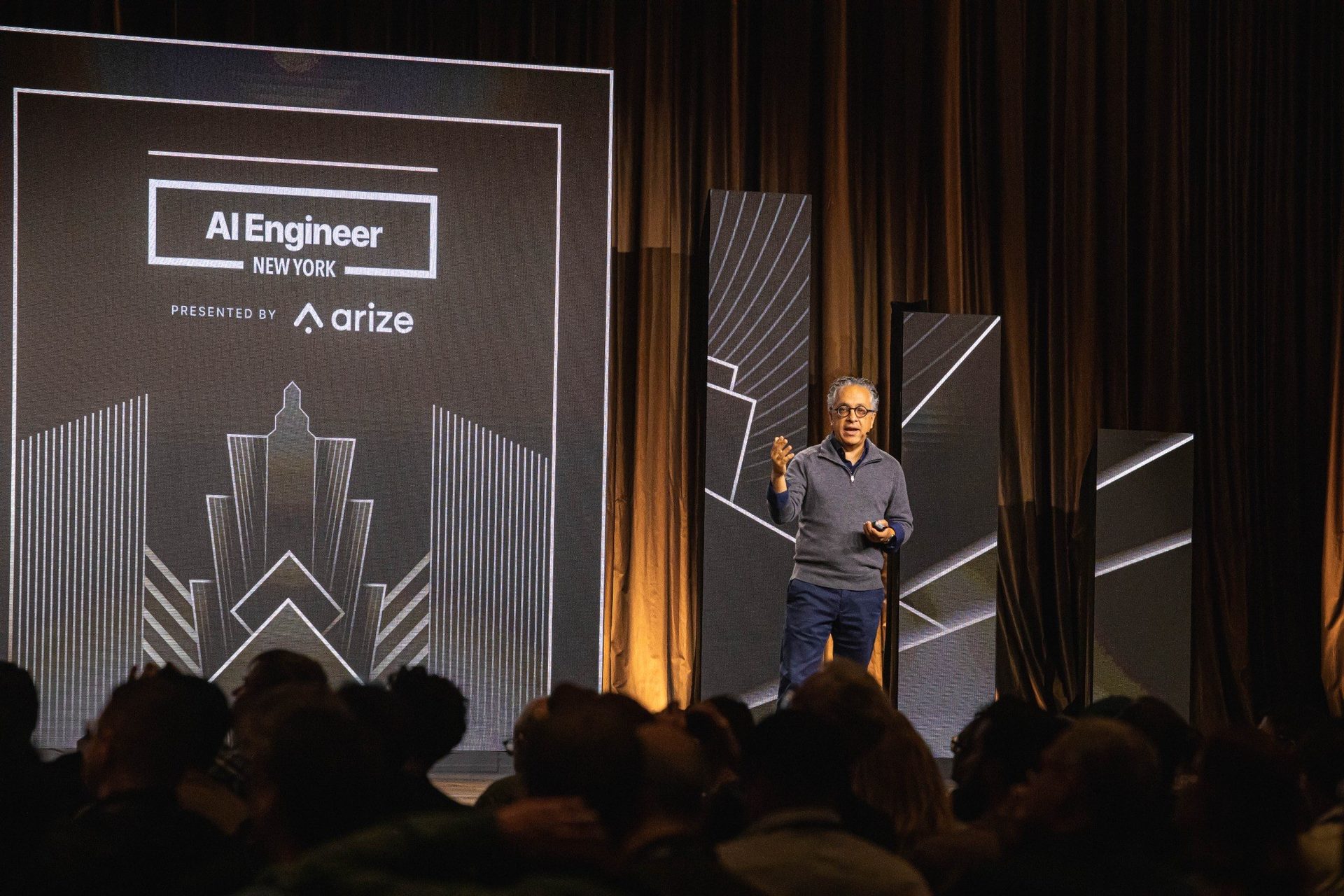
Tariq Shaukat is CEO of Sonar, which builds code-quality and code-security tools. His main-stage presentation used a familiar industrial story as a lens on AI-generated software: the move from high-volume automotive production to quality-engineered manufacturing — the Toyota lesson. Fix root causes. Build quality into the process. Solve problems early. Give teams the means to improve the system.
“Fix systems not symptoms.” “Solve problems as they occur.”
Speaker evidence Sonar cited a study showing 2,450% growth in lines of code and 240% growth in commits — while releases rose only 30%. That is the speaker’s evidence, not an audited figure, but the point is clear: more code is not the same as more value. Generated output can rise faster than an organisation’s capacity to review it.
EMM Studio analysis Twenty years of software-delivery discipline — quality gates, automated testing, workflow mapping, change control, incident response, versioning — becomes more valuable when AI accelerates output. These are the brakes that let a fast car go fast safely. AI can accelerate both good and poor engineering.
What is a technology stack — and why does it still matter?
A technology stack is the set of layers that make a piece of software work: the interface people use, the APIs that connect services, identity and access controls, the business logic, the databases and data platforms, the infrastructure it runs on, how it is deployed, how it is monitored and how it is secured.
Each layer answers a question a demo can ignore. Who is this user, and what may they see? Where does this data come from, and is it right? What happens when a service is down? How do we roll back a bad change? Who gets paged at 2am? Architecture, security, testing, integration, maintainability and service operations still decide whether AI survives contact with production.
Deterministic and probabilistic
Conventional software is deterministic: given the same inputs and conditions, explicit rules produce predictable results. Approved financial calculations, business rules and permission checks work this way — and should. AI models are probabilistic: they use learned patterns to interpret information and generate likely answers. They handle ambiguity and unfamiliar tasks well, but their results are not inherently guaranteed, so they need evaluation and constraints.
Good enterprise architecture deliberately combines the two, with trusted data, secure infrastructure and human decisions. Use conventional code where the answer must be exact and repeatable; use AI for bounded interpretation where information is messy; keep humans for consequential judgement.
- 01AI interprets the requestProbabilistic: understands messy language
- 02Conventional systems calculateDeterministic: approved logic
- 03Permissions restrict actionsEnforced outside the model
- 04A professional approvesHuman accountability
EMM Studio illustration, from The AI Advantage report, p24.
Wrappers, harnesses and stacks
Three terms are often confused. They describe very different levels of maturity:
What an agent harness does
An AI agent harness is the software environment around a model that manages how it works. It supplies context, connects authorised tools, coordinates steps, maintains state, applies permissions, records activity, handles failures and supports testing. Without one, a capable model is a clever conversationalist. With one, it can take controlled action across real systems.
- Context, instructions & memoryWhat the model is told, and the working information it can see for this task
- Tools, APIs & data connectionsThe approved systems it may call, and how
- Agent control loop & orchestrationHow steps are sequenced, repeated, retried or stopped
- Identity, permissions & human approvalWho the agent is acting as, what it may do, and who signs off
- Sandbox & execution isolationWhere code and actions run, separated from critical systems
- Evaluation, tracing & monitoringWhat it actually did, and whether that was good enough
Speaker evidence At AI Engineer New York, financial-services platform discussions described multiple agent harnesses, shared model gateways, team configurations, evals, knowledge systems and a “meta-harness” layer for portability. A Modal technical presentation described separating the agent harness from code-execution environments, for security and isolation. These are paraphrased conference examples, not quotations or descriptions of any one firm’s internal system.
Anthropic’s keynote, explored in Part 3, made the same point from another angle: connectors, skills, permissions, approvals and evals built once, so every new agent inherits them.
Why experience matters more, not less
As code generation accelerates, the scarce skill is knowing what to build, how it will fail and how to keep it running. Experienced engineers know how complex programmes break. A new generation of AI engineers brings speed and fluency with agent tools. EMM Studio analysis This is a generational opportunity, not a generational contest. Experience isn’t the opposite of innovation; it is how innovation scales.
The practical implication is organisational. Pair AI-native builders with experienced engineers, operations leaders, process owners and risk specialists. Don’t let a fast-moving “AI team” build in a silo next to the teams who will have to run, secure and support what it ships. Workflows aren’t a new invention — process maps, triggers, exceptions, handoffs and service levels have been part of enterprise transformation for decades. A workflow that once took months of integration can now be prototyped quickly. That is an opportunity to redesign the work, not a licence to skip the design.
What technical teams should be able to answer
- 01Which tasks genuinely need frontier reasoning, and which can use smaller models or conventional code?
- 02How will the system handle unavailable tools, missing data and unexpected user behaviour?
- 03What evidence supports performance beyond curated demonstrations?
- 04Can we change models or vendors without rebuilding the whole workflow?
- 05What permissions and audit records exist for every material action?
- 06Who reviews AI-generated code, and how do we track escaped defects and change failure rate?
From The AI Advantage report, pp18 and 36. EMM Studio analysis.
The question to take into Monday
Are you building isolated agents, or the foundations that allow them to scale?
Related reading