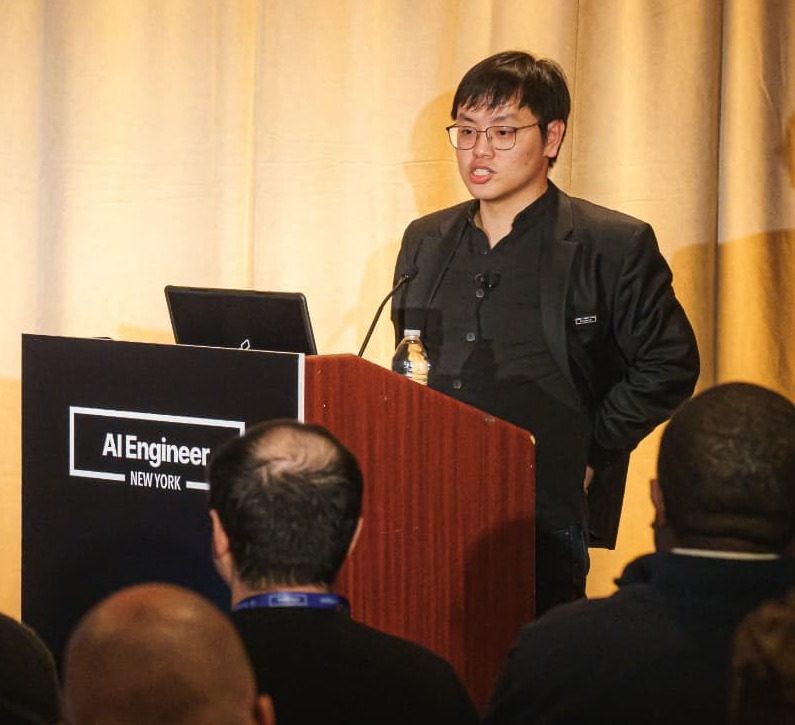
Among the many experiences at AI Engineer New York, one stood out: the Token Billionaires Lounge. A velvet rope, door staff, a live house band, styling and grooming by the window. It was theatrical, generous and very New York — and its name pointed straight at one of the biggest commercial conversations in AI.
Welcome to the Token Billionaires Lounge
Firsthand The lounge was a Devin-branded space. Devin is the AI software engineer built by Cognition, an applied AI lab building end-to-end software agents; Cognition also sponsored the conference’s Leadership Reception, according to the official schedule. The lounge brought a sense of exclusivity and fun to the event — a creative expression of the extraordinary momentum behind AI engineering, and an experience that captured the personality of the community. Credit to the organisers and the sponsor for making it memorable.

The name also reflected something increasingly important. As AI agents take on more complex work, they consume vast quantities of tokens. For developers, token consumption is part of everyday engineering. For businesses deploying AI at scale, it is fast becoming a significant operating cost.
What is a token?
Tokens are the pieces of information an AI model processes and produces. A token is not a word, and not a unit of money: a sentence is split into many tokens, and a long word may become several. Exact splits vary by model. Providers typically price usage by the number of tokens going in and coming out.
Every request has input tokens — your prompt, the system’s instructions, any documents and the conversation so far — and output tokens: the response, code, reasoning steps and actions the model produces. The context window is the working information a model can use for one task. It isn’t permanent memory; what isn’t in the window, the model doesn’t see. Bigger windows let agents read more — and pay for more.
The metered electricity of AI
A useful metaphor: an electricity bill depends on how much you consume, and the AI bill often depends on tokens processed. But the metaphor has limits. Unlike electricity, the rate also changes with which model you use, input versus output, caching, tool calls, speed and capacity — and how many times the system loops.
- 01Business task“Summarise this client’s file and draft a reply.”
- 02Input tokensPrompt, instructions, documents, context
- 03Model or agentMay call tools and repeat — each loop reads context again
- 04Output tokensResponse, code, reasoning, actions
- 05Total workload costEvery step, loop and retry — times the number of tasks
EMM Studio original diagram. Concepts informed by Eugene Cheah, Featherless AI, “Tokenomics 101” workshop. No prices implied.
This is why agentic AI changes the economics. A single request may be cheap. An agent working all day across thousands of cases — re-reading long histories, calling other services, retrying when something fails — can generate a very large volume of tokens. The bill grows with volume, context and repetition, not just the length of the final answer.
“The AI bill is too damn high.”
That was the title of a slide from Eugene Cheah, CEO and co-founder of Featherless AI — an inference platform for running open-weight models — in his “Tokenomics 101” workshop. Its subtitle framed the real task: optimising the cost per task, from billions to trillions of tokens. Cheah’s argument was that most organisations look at the price of a token and stop there. The bigger savings sit in what you measure, which model does which job, when you pay for speed and how you buy capacity.
Six lessons for the AI bill
- 01See itReport cost by team, workload, model and successful outcome — and give each line an owner. Total tokens alone is not enough.
- 02Right-size the modelStart with a capable model, build task-specific evals, then test smaller or specialised models against your own quality bar.
- 03Buy speed when people waitInteractive work with a person waiting may justify premium latency. Unattended background work can run in cheaper queues.
- 04Match capacity to usageDedicate capacity to a predictable baseline only when the economics justify it; use on-demand for bursts.
- 05Behaviour mattersDefaults, speed, policy and measurement shape the bill as much as the price list.
- 06Measure outcomesConnect the bill to accepted work, review effort, quality and end-to-end cycle time.
Ideas presented by Eugene Cheah, Featherless AI, “Tokenomics 101”; summarised by EMM Studio.
Right-size the model
Not every task needs the most capable — and most expensive — frontier model. A practical path described in the workshop: start on a frontier model to learn what good looks like; collect real results and fine-tune or distil a smaller specialist; route a growing share of traffic to it while measuring quality; then cut over, keeping a small share on the larger model as a check. Ramp Labs made a related point on stage: a cheaper model that fails more often can increase total cost. Right-sizing only works with evals.
Pay for speed only where a person is waiting
- Fastest · Person waitingPremium latency can be worth it
- Balanced · Agent runningSteady throughput; minutes matter, seconds less
- Lowest cost · Background batchOvernight or queued; cheapest per token
Bar length = latency priority (illustrative). EMM Studio graphic adapted from the Featherless AI slide “Pay for speed only where a person is waiting”.
Interactive work earns the premium. Work nobody is watching can wait for a cheaper queue. And on capacity: usage rarely runs flat. Dedicated capacity pays for itself only when it is busy most of the time; bursts above the base are often cheaper on demand. Before negotiating price, find out what your base load actually is.
Behaviour shapes the bill
Speaker evidence A Featherless slide argued, provocatively, that “nobody switches models to save the company money”: given a free choice, developers tended to stay on the largest model, and usage shifted only when the cheaper option was also faster. The slide’s percentages came from Featherless’s own observations and couldn’t be verified, so we use only the qualitative point. Another slide — “People get faster. Organizations don’t.” — warned that individual speed gains can disappear into longer review queues.
Six questions for Monday
- 01Can we see spend by team and by workload?
- 02What test must a cheaper model pass?
- 03What is our base load in a normal week?
- 04Who sets the default model for each team?
- 05Which workloads have a person waiting?
- 06How much of what we generate gets used?
Adapted from the Featherless AI slide “Six questions for Monday”, Eugene Cheah, Tokenomics 101 workshop, AI Engineer New York 2026.
Measure the outcome, not the tokens
EMM Studio analysis More tokens used does not mean more business value. The metric to optimise is the cost per successful, quality-checked outcome — including retries and human review.
Cost per accepted outcome
In practice: (inference + retrieval + tool calls + human review + retries + monitoring) divided by the number of successfully completed, quality-checked outcomes. That turns AI spend from a technology line item into an operating-model question: who owns each workload, what quality is required, and what a successful outcome is worth.
The question to take into Monday
Can you link AI consumption to a business outcome?
Related reading